

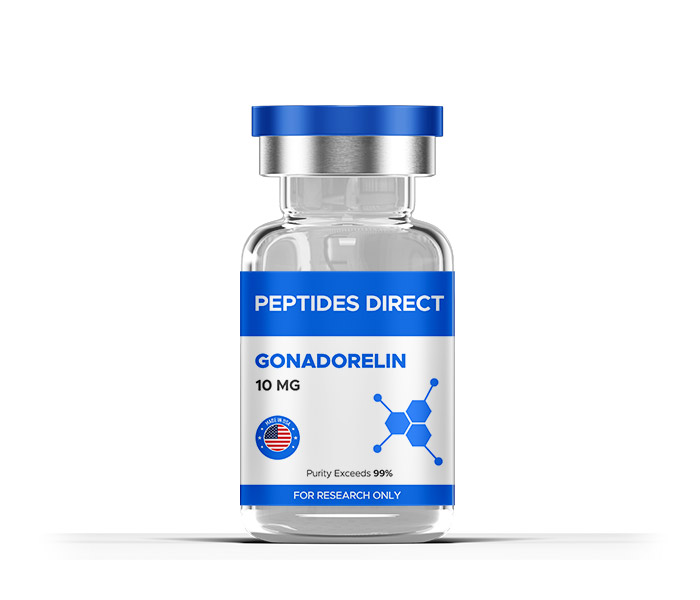
Gonadorelin (GnRH) (10mg)
$79.00
Gonadorelin (GnRH) peptides are Synthesized and Lyophilized in the USA.
Gonadorelin (GnRH) Peptide
Gonadorelin (GnRH) is a decapeptide gonadotropin-releasing hormone agonist.[1] It appears to work by stimulating the synthesis and release of luteinizing hormone and follicle-stimulating hormone. It is being researched within the context of infertility and reproductive systems, and hypogonadism. It is also studied for its potential as a diagnostic tool to assess pituitary function.[2]
Specifications
Molecular Formula: C55H75N17O13
Sequence: Pyr-His-Trp-Ser-Tyr-Gly-Leu-Arg-Pro-Gly
Molecular Weight: 1182.311 g/mol
Other Known Titles: Growth Hormone Releasing Factor, Somatocrinin, Somatoliberin
Gonadorelin Research
Gonadorelin and GnRH Receptors
Similar to GnRH, Gonadorelin is proposed to exert its effects through GnRH receptors — receptors that appear to be highly sensitive to downregulation. While intermittent exposure to GnRH and Gonadorelin activates these receptors to produce physiological responses such as LH and FSH release, continuous activation via Gonadorelin may downregulate and inactivate the receptors, rendering them unresponsive to native GnRH.[3] The method of experimentation may therefore be a determining factor in whether Gonadorelin upregulates or downregulates LH and FSH release — hormones considered essential to the functioning of the hypothalamic-pituitary-gonadal (HPG) axis. The suppressive actions of Gonadorelin on LH and FSH production may carry research potential in the context of cancer cell experimentation and experimental models of dementia, while its stimulatory action under intermittent exposure is being investigated for reactivating the HPG axis and in experimental models of cryptorchidism and spermatogenesis impairment.
Gonadorelin Research and Breast Cancer
Research into Gonadorelin and ovarian cancer has suggested the peptide may demonstrate potential in mitigating the onset of certain cancers through regulation of estrogen production.[3] Scientists reported that “fusion of GnRH to hpRNase1 structure produced an enzyme that could specifically target tumor cells.”[4] Extended studies in animal models of breast cancer indicated that Gonadorelin exposure may reduce the risk of cancer cell proliferation by up to 70%, depending on duration of exposure.[5] Research has further suggested that estrogen-inhibiting measures may reduce disease progression by up to 50% in estrogen-sensitive cancers. Cancer cells are understood to develop resistance over time, typically through increased expression of estrogen receptors. Gonadorelin may directly attenuate the growth of estrogen-sensitive cancers and enhance receptor efficacy, as proposed by researchers.[6] Studies in research models of hyperandrogenism have additionally suggested that prolonged GnRH exposure may lower total estrogen levels and reduce the risk of breast cancer cell growth and proliferation.[7]
Gonadorelin and Prostate Cancer
Research into GnRH exposure in prostate cancer models dates to 1979. Researchers observed that certain androgens are produced locally within the prostate through a mechanism referred to as intracrinology.[8] GnRH was proposed to function as a blockade in this context, though findings suggested only partial efficacy in attenuating prostate cancer cell growth and proliferation.
Gonadorelin and Dementia
Luteinizing Hormone (LH) is considered to exert effects on the brain that extend beyond its conventional associations with sexual dimorphism and fertility. Elevated LH levels have been proposed to correlate positively with incidences of Alzheimer’s disease and diminished memory capacity. Rats exposed to higher LH levels exhibited impaired memory and hippocampal dysfunction — a deficit that appeared to be remedied through the influence of LH blockers.[10] Further research into LH has indicated that elevated hormone levels are associated with increased neuropathology, with LH proposed to promote the formation of plaques associated with Alzheimer’s disease.[11] Researchers concluded that “reducing the LH levels by [exposure] with gonadotropin-releasing hormone agonists could provide [numerous] benefits,” suggesting that lowering LH levels may help slow the progression of Alzheimer’s disease. As testosterone is considered beneficial for maintaining cognitive function, inhibiting the entire hypothalamic-pituitary-gonadal axis may not always represent the most appropriate approach to addressing Alzheimer’s disease. For this reason, researchers have sought to investigate Gonadorelin derivatives to determine whether selective disruption of LH production may be achievable.[12]
One ongoing study has suggested that Leuprolide — a compound commonly associated with uterine fibroids and GnRH receptor agonists — may potentially reduce the risk of Alzheimer’s disease relative to other gonadotropin analogs. In this context, Leuprolide may help offset the risk of cognitive decline associated with Alzheimer’s disease. Researchers examined the apparent capacity of Leuprolide to downregulate serum gonadotropin levels, particularly LH, and found this generally sufficient to offset the effects of reduced testosterone.[13] Ongoing research continues to investigate how the genetic interactions underlying Alzheimer’s disease may be disrupted, with Gonadorelin representing an important area of study.
Gonadorelin and Cryptorchidism
Research involving pulsatile and intermittent pituitary cell exposure to Gonadorelin has indicated potential positive effects in facilitating testicular descent in models of cryptorchidism — a condition characterized by the absence of one or both testes from the scrotum, related to developmental processes of the HPG axis. This axis plays a critical role in regulating reproductive and hormonal function. Investigative findings suggest a possibility, though not a certainty, that Gonadorelin may hold potential in approximately 40% of cases to support HPG axis development — particularly regarding the maturation of testicular structures — compared to a control group.[15]
Gonadorelin and Spermatogenesis
Research has explored the possibility that intermittent Gonadorelin exposure in pituitary cells may offer utility in models of hypothalamic dysfunction — a condition characterized by disrupted endogenous GnRH synthesis.[16] Gonadorelin has been suggested to potentially reactivate the HPG axis under such circumstances through a proposed sequence of stimulatory events beginning at the pituitary gland, prompting the production of LH and FSH. These hormones may subsequently stimulate testicular cells to generate androgens. Experiments spanning at least five months have proposed that such intermittent exposure may lead to successful spermatogenesis.[17] The success of this process is thought to depend significantly on the capacity of testicular cells to produce testosterone endogenously.
Gonadorelin and PCT
The introduction of exogenous androgens may potentially suppress HPG axis function, with recovery following cessation occurring gradually. Intermittent exposure to the peptide hormone Gonadorelin has been investigated as a means of potentially accelerating this recovery. In one study, exogenous androgens were observed to suppress LH and FSH levels to below 0.5 international units per liter (IU/L) and reduce endogenous testosterone — naturally produced by testicular cells — to approximately 4.5 nanomoles per liter (nmol/L).[18] A brief experimental exposure to Gonadorelin, by contrast, was associated with marked increases in these hormones, with LH levels rising to as high as 7.9 IU/L, FSH levels to 2.4 IU/L, and endogenous testosterone to 13.3 nmol/L. Notably, these elevated hormone levels appeared to persist for over a year without further Gonadorelin exposure — suggesting that Gonadorelin may play a meaningful role in restoring the hormonal balance disrupted by exogenous androgen use.
Disclaimer: The products mentioned are not intended for human or animal consumption. Research chemicals are intended solely for laboratory experimentation and/or in-vitro testing. Bodily introduction of any sort is strictly prohibited by law. All purchases are limited to licensed researchers and/or qualified professionals. All information shared in this article is for educational purposes only.
References
- Pace JN, Miller JL, Rose LI. GnRH agonists: gonadorelin, leuprolide and nafarelin. Am Fam Physician. 1991 Nov;44(5):1777-82. PMID: 1835275.
- Meethal SV, Smith MA, Bowen RL, Atwood CS. The gonadotropin connection in Alzheimer’s disease. Endocrine. 2005 Apr;26(3):317-26. doi: 10.1385/ENDO:26:3:317. PMID: 16034187.
- Bhasin S, Yuan QX, Steiner BS, Swerdloff RS. Hormonal effects of gonadotropin-releasing hormone (GnRH) agonist in men: effects of long term treatment with GnRH agonist infusion and androgen. J Clin Endocrinol Metab. 1987 Sep;65(3):568-74. doi: 10.1210/jcem-65-3-568. PMID: 3114307.
- Maleksabet A, Zarei Jaliani H, Asgari A, Ramezani A, Erfani N. Specific Targeting of Recombinant Human Pancreatic Ribonuclease 1 using Gonadotropin-Releasing Hormone Targeting Peptide toward Gonadotropin-Releasing Hormone Receptor-Positive Cancer Cells. Iran J Med Sci. 2021 Jul;46(4):281-290. doi: 10.30476/ijms.2020.83234.1219. PMID: 34305240; PMCID: PMC8288496.
- Secreto G, Girombelli A, Krogh V. Androgen excess in breast cancer development: implications for prevention and treatment. Endocr Relat Cancer. 2019 Feb;26(2):R81-R94. doi: 10.1530/ERC-18-0429. PMID: 30403656.
- Spicer DV, Pike MC. Sex steroids and breast cancer prevention. J Natl Cancer Inst Monogr. 1994;(16):139-47. PMID: 7999456.
- Secreto G, Muti P, Sant M, Meneghini E, Krogh V. Medical ovariectomy in menopausal breast cancer patients with high testosterone levels: a further step toward tailored therapy. Endocr Relat Cancer. 2017 Nov;24(11):C21-C29. doi: 10.1530/ERC-17-0251. Epub 2017 Aug 16. PMID: 28814452.
- Vollaard ES, van Beek AP, Verburg FA, Roos A, Land JA. Gonadotropin-releasing hormone agonist treatment in postmenopausal women with hyperandrogenism of ovarian origin. J Clin Endocrinol Metab. 2011 May;96(5):1197-201. doi: 10.1210/jc.2010-1991. Epub 2011 Feb 9. PMID: 21307133.
- Labrie F. GnRH agonists and the rapidly increasing use of combined androgen blockade in prostate cancer. Endocr Relat Cancer. 2014 Aug;21(4):R301-17. doi: 10.1530/ERC-13-0165. Epub 2014 May 13. PMID: 24825748.
- Labrie F. Combined blockade of testicular and locally made androgens in prostate cancer: a highly significant medical progress based upon intracrinology. J Steroid Biochem Mol Biol. 2015 Jan;145:144-56. doi: 10.1016/j.jsbmb.2014.05.012. Epub 2014 Jun 9. PMID: 24925260.
- Burnham V, Sundby C, Laman-Maharg A, Thornton J. Luteinizing hormone acts at the hippocampus to dampen spatial memory. Horm Behav. 2017 Mar;89:55-63. doi: 10.1016/j.yhbeh.2016.11.007. Epub 2016 Nov 12. PMID: 27847314.
- Rao CV. Involvement of Luteinizing Hormone in Alzheimer Disease Development in Elderly Women. Reprod Sci. 2017 Mar;24(3):355-368. doi: 10.1177/1933719116658705. Epub 2016 Jul 20. PMID: 27436369.
- Bowen RL, Butler T, Atwood CS. Not All Androgen Deprivation Therapies Are Created Equal: Leuprolide and the Decreased Risk of Developing Alzheimer’s Disease. J Clin Oncol. 2016 Aug 10;34(23):2800. doi: 10.1200/JCO.2015.66.3997. Epub 2016 Jun 13. PMID: 27298416; PMCID: PMC5019750.
- Smith MA, Bowen RL, Nguyen RQ, Perry G, Atwood CS, Rimm AA. Putative Gonadotropin-Releasing Hormone Agonist Therapy and Dementia: An Application of Medicare Hospitalization Claims Data. J Alzheimers Dis. 2018;63(4):1269-1277. doi: 10.3233/JAD-170847. PMID: 29782310.
- Lepor, Herbert. “Comparison of single-agent androgen suppression for advanced prostate cancer.” Reviews in urology vol. 7 Suppl 5,Suppl 5 (2005): S3-S12. https://www.ncbi.nlm.nih.gov/pmc/articles/PMC1477619/
- Zhang, L., Cai, K., Wang, Y., Ji, W., Cheng, Z., Chen, G., & Liao, Z. (2019). The Pulsatile Gonadorelin Pump Induces Earlier Spermatogenesis Than Cyclical Gonadotropin Therapy in Congenital Hypogonadotropic Hypogonadism Men. American journal of men’s health, 13(1), 1557988318818280. https://doi.org/10.1177/1557988318818280
- Muzzi, G., Bartolotta, E., Cherubini, V., & Lomiento, D. (1990). Effetti del trattamento con LH-RH sintetico spray nasale nel criptorchidismo [Effects of the treatment using synthetic LH-RH nasal spray in cryptorchism]. La Pediatria medica e chirurgica : Medical and surgical pediatrics, 12(1), 53–55.
- Blumenfeld, Z., Makler, A., Frisch, L., & Brandes, J. M. (1988). Induction of spermatogenesis and fertility in hypogonadotropic azoospermic men by intravenous pulsatile gonadotropin-releasing hormone (GnRH). Gynecological endocrinology : the official journal of the International Society of Gynecological Endocrinology, 2(2), 151–164. https://doi.org/10.3109/09513598809023623
Reviews
There are no reviews yet.