

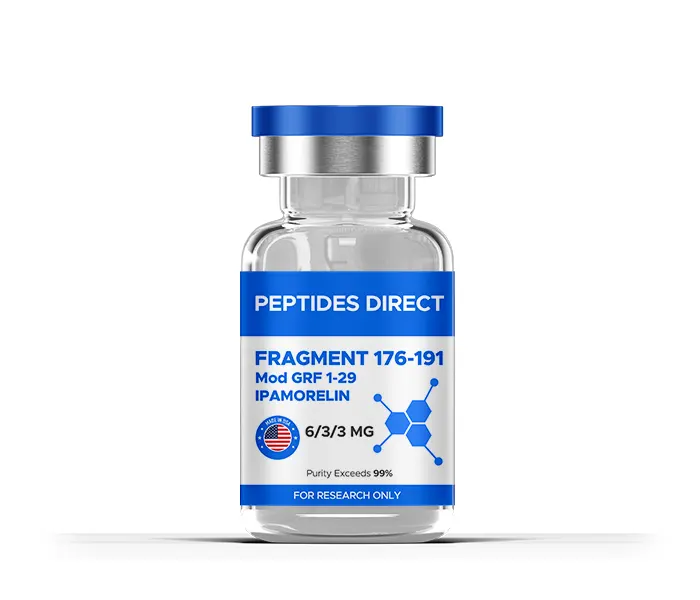
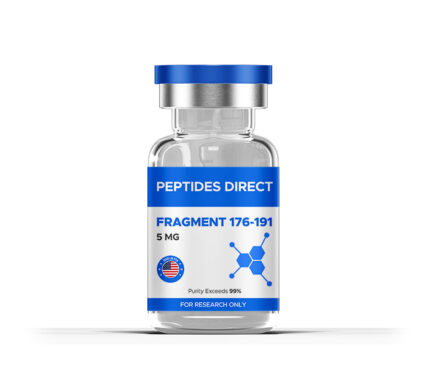
Fragment 176-191 & Mod GRF 1-29 & Ipamorelin Blend (12mg)
$87.00
Fragment 176-191 & Mod GRF 1-29 & Ipamorelin peptides blend are Synthesized and Lyophilized in the USA.
Fragment 176-191 & Mod GRF 1-29 & Ipamorelin Peptide Blend
Studies have suggested that a maximal output of endogenous growth hormone (GH) from the anterior pituitary gland might be attained through a combination of growth hormone-releasing hormone (GHRH) analog and agonist of growth hormone secretagogue receptor (GHSR).[1] The combination of Ipamorelin with Modified GRF is one of the various combinations researchers have studied in an effort to achieve maximal growth hormone production. Interestingly, more specific results appear to be achieved beyond the increase in GH synthesis by refining the choice of GHRH and GHSR evaluated in a particular study. Modified GRF, which researchers have suggested may be a potent GHRH analog, may have impacts beyond growth hormone release. It has been speculated to impact intestinal inflammation, tissue repair, and cardiac function in addition to researchers’ suppositions on its impact on growth hormone release. Ipamorelin, classified as a growth hormone secretagogue, appears to interact with the GHSRs, also known as ghrelin receptors, and may have the potential to impact bone growth. Activating the ghrelin receptors may affect appetite, to increase food consumption and total weight gain. Depending on the desired outcome of the particular study, namely the addition or reduction of weight, this specific receptor activity may be mitigated by adding lipolytic molecules, which may help minimize the possibility of fat increase. Fragment 176-191 is often combined with Ipamorelin and other research peptides. The peptide known as Fragment 176-191, also referred to as hGH Fragment 176-191, Frag 176-191, tyr-hGH 177-191, or AOD-9604, is hypothesized to specifically target the fat-reduction pathways of growth hormone. This peptide consists of a sequence of 16 amino acids derived from the terminal portion of the growth hormone molecule, identified by researchers as the “lipolytic fragment” due to its potential fat-burning capabilities. The term ‘lipolytic’ describes the fragment’s capacity to promote fat breakdown. To enhance the peptide’s stability, the initial amino acid in the hGH Fragment 176-191 sequence is substituted with tyrosine, leading to its alternate designation as Fragment tyr-hGH 177-191.[2][3]
Fragment 176-191 Specifications
Molecular Formula: C78H125N23O23S2
Molecular Weight: 1817.1 g/mol
Sequence: Tyr-Leu-Arg-Ile-Val-Gin-Cys-Arg-Ser-Val-Glu-Gly-Ser-Cys-Gly-Phe
Mod GRF 1-29 Specifications
Molecular Formula: C152H252N44O42
Molecular Weight: 3367.95 g/mol
Sequence: H-Tyr-D-Ala-Asp-Ala-Ile-Phe-Thr-Gln-Ser-Tyr-Arg-Lys-Val-Leu-Ala-Gln-Leu-Ser-Ala-Arg-Lys-Leu-Leu-Gln-Asp-Ile-Leu-Ser-Arg-NH2
Ipamorelin Specifications
Molecular Formula: C38H49N9O5
Molecular Weight: 711.86 g/mol
Sequence: Aib-His-D-2Nal-D-Phe-Lys-NH2
Fragment 176-191 & Mod GRF 1-29 & Ipamorelin Peptide Research
Frag 176-191 & Mod GRF 1-29 & Ipamorelin and Growth Hormone Pulsatility
While no direct studies have focused specifically on Modified GRF 1-29 actions, research has been conducted on structurally similar peptides. One study evaluated the influence of a Modified GRF 1-29 analog on various physiological functions including growth hormone and IGF-1 production, skin cell proliferation, and muscle tissue growth. Findings indicated that the analog may potentially influence the growth hormone-IGF-1 signaling pathway, with results cautiously suggesting the peptide might enhance growth hormone release by 70% to 107% over a 12-hour period from anterior pituitary somatotroph cells. A rise in IGF-1 levels of approximately 28% was additionally observed, potentially suggesting enhanced functionality of the growth hormone-IGF-1 axis.[4] Further research has also indicated that Ipamorelin may increase growth hormone levels to approximately 80 mIU/l (equivalent to 26.6 ng/ml) — a substantial increase relative to control baseline levels of 1.31 mIU/l or 0.4 ng/ml, potentially representing a more than 60-fold elevation.[5]
Frag 176-191 & Mod GRF 1-29 & Ipamorelin and Body Composition
Researchers have sought to identify potential in these peptides to promote fat cell reduction and support muscle cell development. Of the three, Fragment 176-191 is considered to carry a lipolytic fragment, appearing to act on beta-3 adrenergic receptors (ADRB3). The peptide has been proposed to increase fat cell dissolution in adipose tissue and support fat breakdown through thermogenesis induction in skeletal muscles via these receptors.[6] Researchers observed that knockout mice lacking ADRB3 receptors appeared not to respond to Fragment 176-191’s actions,[7] while the peptide may also engage additional cellular signaling pathways that indirectly support fat metabolism — potentially by modulating pathways that increase expression of enzymes critical to lipolysis or by enhancing cellular responsiveness to lipolytic signals through secondary messenger regulation.
Notably, Fragment 176-191 appeared to produce weight loss only in obese mice, with no apparent effect in lean animals, and was reported to reduce weight gain in obese mice by nearly 50% over three weeks. This has also been investigated clinically, with the METAOD005 study assessing the fat-reducing potential of the peptide over 12 weeks. Preliminary findings suggest one Fragment 176-191 test group may have experienced a reduction in body weight of approximately 5.7 pounds, with potential contributions to improved cholesterol profiles and glucose tolerance also hypothesized.[8]
Other components of this blend, such as Mod GRF (1-29), have been investigated for their potential to improve body composition through increased muscle cell development — with apparent increases in muscle mass potentially attributable to two mechanisms: muscle hypertrophy (increased muscle fiber size) and muscle hyperplasia (increased muscle fiber number). Ipamorelin has been proposed to support anabolic activity through its involvement in growth hormone and IGF-1 synthesis. One study examining Ipamorelin’s influence on liver markers related to alpha-amino-nitrogen transformation during catabolic states assessed the liver’s capacity to produce urea-N (CUNS) as a measure of nitrogen processing. Researchers examined mRNA levels for urea cycle enzymes, evaluated overall nitrogen balance, and theorized nitrogen distribution among various organs. Preliminary results indicated that Ipamorelin exposure may be associated with an approximately 20% reduction in CUNS compared to induced catabolic conditions, alongside a potential decrease in urea cycle enzyme expression and possible re-establishment of nitrogen balance.[9]
Frag 176-191 & Mod GRF 1-29 & Ipamorelin and Bone, Joint Function
In a study evaluating growth hormone’s influence on osteoarthritis outcomes, researchers suggested that hGH Fragment 176-191 introduced in conjunction with hyaluronic acid may potentiate joint cartilage growth. Animal model studies of osteoarthritis appeared to show improvements in joint cartilage following peptide exposure,[10] with results reportedly more pronounced when the peptide was combined with hyaluronic acid. Kwon et al. concluded that “AOD9604 [exposure] using ultrasound guidance enhanced cartilage regeneration, and combined AOD9604 and HA were more effective than HA or AOD9604 alone in the collagenase-induced knee OA rabbit model.”
Peptides such as Modified GRF 1-29 and Ipamorelin have additionally been suggested to support bone function by activating bone cells through GH-mediated pathways, potentially leading to increased activity, proliferation, and differentiation of bone-forming cells, as well as improvements in bone mineral density (BMD) or bone mineral content (BMC). Ipamorelin specifically has been proposed to potentially enhance bone mineral density through activation of osteoblasts — cells responsible for bone formation — via GH-mediated mechanisms, with potential increases in proliferation, cell growth, and differentiation.
In one study, mice were exposed to either Ipamorelin or a control compound, with bone mineral density effects monitored using real-time dual X-ray absorptiometry (DEXA) at key anatomical sites including the femur and L6 vertebra, followed by further femoral analysis via mid-diaphyseal peripheral quantitative computed tomography (pQCT). Initial results suggested the peptide may have contributed to increased body mass and potentially higher bone mineral content (BMC) in the tibia and vertebrae compared to controls. pQCT data further suggested the observed increase in cortical BMC may be attributable to an increase in bone cross-sectional area, while cortical volumetric BMD appeared to remain stable — implying an expansion in femoral and L6 vertebral volume given the concurrent BMC increase and stable volumetric density.[11]
Frag 176-191 & Mod GRF 1-29 & Ipamorelin and Cell Aging
A combination of growth hormone-stimulating peptides — a category in which these three are classified — may potentially stimulate a natural increase in growth hormone levels. Elevated growth hormone has been associated with improved cell proliferation attributed to attenuation of telomere shortening, alongside a reduction in cellular death associated with decreased oxidative stress.[12]
Disclaimer: The products mentioned are not intended for human or animal consumption. Research chemicals are intended solely for laboratory experimentation and/or in-vitro testing. Bodily introduction of any sort is strictly prohibited by law. All purchases are limited to licensed researchers and/or qualified professionals. All information shared in this article is for educational purposes only.
References
- Sinha DK, Balasubramanian A, Tatem AJ, Rivera-Mirabal J, Yu J, Kovac J, Pastuszak AW, Lipshultz LI. Beyond the androgen receptor: the role of growth hormone secretagogues in the modern management of body composition in hypogonadal males. Transl Androl Urol. 2020 Mar;9(Suppl 2):S149-S159. doi: 10.21037/tau.2019.11.30. PMID: 32257855; PMCID: PMC7108996.
- Cox HD, Smeal SJ, Hughes CM, Cox JE, Eichner D. Detection and in vitro metabolism of AOD9604. Drug Test Anal. 2015 Jan;7(1):31-8. doi: 10.1002/dta.1715. Epub 2014 Sep 10. PMID: 25208511.
- Heffernan, Mark, et al. “The Effects of Human GH and Its Lipolytic Fragment (AOD9604) on Lipid Metabolism Following Chronic Treatment in Obese Mice andβ 3-AR Knock-Out Mice.” Endocrinology 142.12 (2001): 5182-5189.
- Khorram, O., Laughlin, G. A., & Yen, S. S. (1997). Endocrine and metabolic effects of long-term administration of [Nle27]growth hormone-releasing hormone-(1-29)-NH2 in age-advanced men and women. The Journal of clinical endocrinology and metabolism, 82(5), 1472–1479. target=”_blank” rel=”noopener”https://doi.org/10.1210/jcem.82.5.3943
- Gobburu, J.V.S., Agersø, H., Jusko, W.J. et al. Pharmacokinetic-Pharmacodynamic Modeling of Ipamorelin, a Growth Hormone Releasing Peptide, in Human Volunteers. Pharm Res 16, 1412–1416 (1999).
- Ferrer-Lorente R, Cabot C, Fernández-López JA, Alemany M. Combined effects of oleoyl-estrone and a beta3-adrenergic agonist (CL316,243) on lipid stores of diet-induced overweight male Wistar rats. Life Sci. 2005 Sep 2;77(16):2051-8. doi: 10.1016/j.lfs.2005.04.008. PMID: 15935402.
- Heffernan M, Summers RJ, Thorburn A, Ogru E, Gianello R, Jiang WJ, Ng FM. The effects of human GH and its lipolytic fragment (AOD9604) on lipid metabolism following chronic treatment in obese mice and beta(3)-AR knock-out mice. Endocrinology. 2001 Dec;142(12):5182-9. doi: 10.1210/endo.142.12.8522. PMID: 11713213.
- Valentino, M A et al. “Central and peripheral molecular targets for antiobesity pharmacotherapy.” Clinical pharmacology and therapeutics vol. 87,6 (2010): 652-62. doi:10.1038/clpt.2010.57
- Aagaard, N. K., Grøfte, T., Greisen, J., Malmlöf, K., Johansen, P. B., Grønbaek, H., Ørskov, H., Tygstrup, N., & Vilstrup, H. (2009). Growth hormone and growth hormone secretagogue effects on nitrogen balance and urea synthesis in steroid treated rats. Growth hormone & IGF research: official journal of the Growth Hormone Research Society and the International IGF Research Society, 19(5), 426–431. https://doi.org/10.1016/j.ghir.2009.01.001
- Kwon DR, Park GY. Effect of Intra-articular Injection of AOD9604 with or without Hyaluronic Acid in Rabbit Osteoarthritis Model. Ann Clin Lab Sci. 2015 Summer;45(4):426-32. PMID: 26275694.
- Svensson, J., Lall, S., Dickson, S. L., Bengtsson, B. A., Rømer, J., Ahnfelt-Rønne, I., Ohlsson, C., & Jansson, J. O. (2000). The GH secretagogues ipamorelin and GH-releasing peptide-6 increase bone mineral content in adult female rats. The Journal of endocrinology, 165(3), 569–577. https://doi.org/10.1677/joe.0.1650569
- Waters MJ, Brooks AJ. Growth hormone and cell growth. Endocr Dev. 2012;23:86-95. doi: 10.1159/000341761. Epub 2012 Nov 23. PMID: 23182823.
Reviews
There are no reviews yet.