

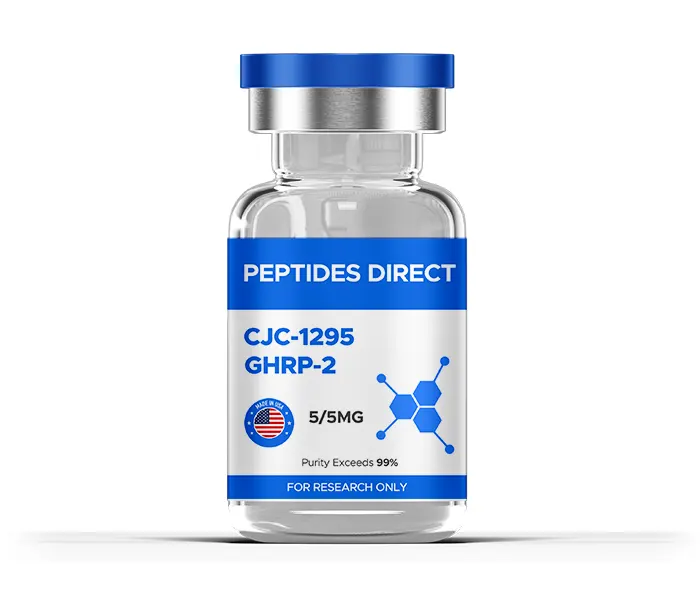
CJC-1295 & GHRP-2 Blend (10mg)
$84.00
CJC-1295 & GHRP-2 blend is Synthesized and Lyophilized in the USA.
CJC-1295 & GHRP-2 Peptide Blend
CJC-1295 & GHRP-2 blend combines two peptides with different structures; both have been researched for their proposed affinity for receptors in the pituitary gland and other parts of the central nervous system. Despite activating different receptors, CJC-1295 & GHRP-2 may exhibit similar action.
CJC-1295 is a molecule that appears to bind to the growth hormone-releasing hormone (GHRH) receptors, which may cause the release of growth hormone by pituitary cells. CJC-1295 is derived from GHRH 1-29, the shortest functional sequence of GHRH consisting of the first 29 amino acids. CJC-1295 is a tetrasubstituted version of the peptide that is also modified by adding a drug affinity complex (DAC) component called N-epsilon-3-maleimidopropionamide, which appears to bind to plasma proteins and may improve CJC-1295 pharmacokinetics.
GHRP-2, or Growth Hormone Releasing Peptide 2, is a synthetic hexapeptide composed of six amino acids. This peptide appears to bind to ghrelin or growth hormone secretagogue 1a receptors (GHS-R1a) found in the hypothalamus and the pituitary gland. As a result, GHRP-2 also appears to stimulate the production of growth hormone (GH) in pituitary cells that express this receptor.
CJC-1295 Specifications
Molecular Formula: C152H252N44O42
Molecular Weight: 3367.9 g/mol
Sequence: H-Tyr-D-Ala-Asp-Ala-Ile-Phe-Thr-Gln-Ser-Tyr-Arg-Lys-Val-Leu-Ala-Gln-Leu-Ser-Ala-Arg-Lys-Leu-Leu-Gln-Asp-Ile-Leu-Ser-Arg-Lys(Mal)-NH2
PubChem: CID 56841945
Other: DOES NOT CONTAIN DAC
GHRP-2 Specifications
Molecular Formula: C45H55N9O6
Molecular Weight: 817.9749 g/mol
Sequence: D-Ala-D-2Nal-Ala-Trp-D-Phe-Lys
CJC-1295 & GHRP-2 Research
CJC-1295 and GHRP-2 Blend and the Pituitary
CJC-1295 appears to exhibit an affinity for pituitary cell GHRH receptors comparable to that of native GHRH. Studies noted that when the peptide was “selected for further pharmacokinetic evaluation, it was found to be present in plasma beyond 72 hours,”[1] suggesting potentially improved pharmacokinetics relative to GHRH. The peptide may additionally demonstrate enhanced capacity for upregulating growth hormone synthesis by somatotroph cells, appearing to stimulate approximately fourfold higher growth hormone secretion — measured by area under the curve — compared to other GHRH receptor agonists such as GRF 1-29.
CJC-1295 may exert these effects by binding to and activating the GHRH receptor, potentially inducing conformational changes that activate intracellular G-proteins located on the receptor’s inner surface.[2] This may stimulate production of second messengers including cAMP and IP3 (inositol trisphosphate), propagating the intracellular signal and potentially activating protein kinases that phosphorylate target proteins and regulate cellular processes.[3] These protein kinases may influence transcription factors that enter the nucleus and modulate transcription of genes associated with growth hormone synthesis and secretion, ultimately triggering fusion of growth hormone-containing secretory vesicles with the plasma membrane. Researchers commented that upon CJC-1295 introduction to pituitary cells, “basal (trough) GH levels were markedly increased (7.5-fold) and contributed to an overall increase in GH secretion (mean GH levels, 46%) and IGF-I levels (45%).”[4]
CJC-1295 and GHRP-2 Blend and IGF-1 Production
Through its interaction with growth hormone production, CJC-1295 may upregulate insulin-like growth factor-1 (IGF-1) levels — considered the primary anabolic mediator of growth hormone. Even brief CJC-1295 exposure in animal models appears to influence mean plasma growth hormone concentrations, with research indicating a 2 to 10-fold rise sustained for six days or potentially longer, with peak growth hormone levels typically achieved within one to four hours of introduction. CJC-1295 may additionally produce observable increases in mean plasma IGF-1 concentrations of 1.5 to 3-fold for approximately 9 to 11 days,[5] with IGF-1 levels potentially remaining elevated for at least two weeks following greater exposure. After multiple administrations, mean IGF-1 levels appear to remain above baseline for up to 28 days, with data suggesting a cumulative effect after two or three exposures — including potentially elevated growth hormone and IGF-1 above baseline on day 14 in many laboratory subjects.
CJC-1295 may upregulate IGF-1 through elevated growth hormone binding to liver cell receptors, potentially initiating intracellular signaling events through the Janus kinase-signal transducer and activator of transcription (JAK-STAT) pathway. Activated STAT proteins may translocate to the nucleus and bind to DNA response elements, potentially leading to IGF-1 gene transcription. Newly synthesized IGF-1 is hypothesized to be released into circulation, acting on various target tissues as a potent growth-promoting hormone that may mediate multiple anabolic and growth-related actions of growth hormone — stimulating cell, tissue, and organ growth and proliferation while potentially supporting protein synthesis and cellular development.
CJC-1295 and GHRP-2 Blend and Potential Synergism
GHRP-2 does not appear to share sequence homology with ghrelin but may carry specific amino acid sequences enabling interaction with ghrelin receptors — specifically GHS-R1a, considered to be primarily located in the hypothalamus and pituitary gland.[6] Non-covalent interactions such as hydrogen bonds and electrostatic forces may facilitate GHRP-2 binding to these receptors, with a conformational change upon binding potentially activating intracellular signaling pathways involving G-proteins. Galphaq/11, a G-protein subunit, may be released and initiate downstream signaling cascades,[7] with phospholipase C (PLC) cleaving phosphatidylinositol 4,5-bisphosphate (PIP2) into IP3 and diacylglycerol (DAG). IP3 may induce calcium ion release while DAG may activate protein kinase C (PKC), potentially amplifying the signaling cascade and stimulating growth hormone release from pituitary cells.[8]
As a result of these proposed interactions, GHRP-2 has been observed to produce an apparent 47-fold increase in pulsatile GH secretion, compared to an approximately 20-fold increase with GHRH-mimetics alone. Notably, the combination of a GHRH-mimetic and GHRP-2 appeared to produce a 54-fold increase in pulsatile GH secretion relative to controls, with GHRP-2 additionally appearing to reduce the time to maximal GH secretion by a median of 43%. These findings have led to the hypothesis that GHRH-mimetics such as CJC-1295 and the secretagogue GHRP-2 may potentially exert synergistic effects when combined.[9]
CJC-1295 and GHRP-2 Blend and Appetite
GHRP-2, as a proposed ghrelin analog, is hypothesized to reflect ghrelin’s role as an appetite-stimulating hormone. Preliminary studies have suggested the peptide may potentially mediate weight increases of over 14 lbs depending on the test model.[10] The proposed appetite-stimulating mechanism is understood to primarily involve GHRP-2’s interaction with the growth hormone secretagogue receptor (GHSR), particularly GHSR-1a — receptors found in the hypothalamus, pituitary gland, and stomach. GHRP-2 binding to hypothalamic GHSR-1a is theorized to trigger a signal transduction cascade potentially leading to increased production of the hunger-inducing neuropeptides Neuropeptide Y (NPY) and Agouti-related peptide (AgRP), both considered significant regulators of energy homeostasis and appetite. Simultaneously, GHRP-2 may inhibit release of the appetite-suppressing hormone melanocyte-stimulating hormone (alpha-MSH), potentially shifting the physiological balance toward increased hunger and food intake.
GHRP-2 may additionally influence the mesolimbic reward system — brain circuitry involved in regulating the desire for palatable food — through its proposed GHSR-1a activation, potentially enhancing food consumption motivation. It is worth noting that while GHRP-2 appears to primarily influence appetite through GHSR-1a interaction, the wide distribution of GHSRs and the multifaceted role of ghrelin suggest broader and more complex effects on overall energy homeostasis. Additional hormonal signals, neuronal inputs, circadian rhythms, and physiological state variables may also modulate its proposed appetite-stimulating effects.
Disclaimer: The products mentioned are not intended for human or animal consumption. Research chemicals are intended solely for laboratory experimentation and/or in-vitro testing. Bodily introduction of any sort is strictly prohibited by law. All purchases are limited to licensed researchers and/or qualified professionals. All information shared in this article is for educational purposes only.
References
- Jetté, L., Léger, R., Thibaudeau, K., Benquet, C., Robitaille, M., Pellerin, I., Paradis, V., van Wyk, P., Pham, K., & Bridon, D. P. (2005). Human growth hormone-releasing factor (hGRF)1-29-albumin bioconjugates activate the GRF receptor on the anterior pituitary in rats: identification of CJC-1295 as a long-lasting GRF analog. Endocrinology, 146(7), 3052–3058. https://doi.org/10.1210/en.2004-1286
- Martin, B., Lopez de Maturana, R., Brenneman, R., Walent, T., Mattson, M. P., & Maudsley, S. (2005). Class II G protein-coupled receptors and their ligands in neuronal function and protection. Neuromolecular medicine, 7(1-2), 3–36. https://doi.org/10.1385/nmm:7:1-2:003
- Newton, A. C., Bootman, M. D., & Scott, J. D. (2016). Second Messengers. Cold Spring Harbor perspectives in biology, 8(8), a005926. https://doi.org/10.1101/cshperspect.a005926
- Ionescu, M., & Frohman, L. A. (2006). Pulsatile secretion of growth hormone (GH) persists during continuous stimulation by CJC-1295, a long-acting GH-releasing hormone analog. The Journal of clinical endocrinology and metabolism, 91(12), 4792–4797. https://doi.org/10.1210/jc.2006-1702
- Teichman, S. L., Neale, A., Lawrence, B., Gagnon, C., Castaigne, J. P., & Frohman, L. A. (2006). Prolonged stimulation of growth hormone (GH) and insulin-like growth factor I secretion by CJC-1295, a long-acting analog of GH-releasing hormone, in healthy adults. The Journal of clinical endocrinology and metabolism, 91(3), 799–805. https://doi.org/10.1210/jc.2005-1536
- Childs, M. D., & Luyt, L. G. (2020). A Decade’s Progress in the Development of Molecular Imaging Agents Targeting the Growth Hormone Secretagogue Receptor. Molecular imaging, 19, 1536012120952623. https://doi.org/10.1177/1536012120952623
- Yin, Y., Li, Y., & Zhang, W. (2014). The growth hormone secretagogue receptor: its intracellular signaling and regulation. International journal of molecular sciences, 15(3), 4837–4855. https://doi.org/10.3390/ijms15034837
- Bill, C. A., & Vines, C. M. (2020). Phospholipase C. Advances in experimental medicine and biology, 1131, 215–242. https://doi.org/10.1007/978-3-030-12457-1_9
- Sinha, D. K., Balasubramanian, A., Tatem, A. J., Rivera-Mirabal, J., Yu, J., Kovac, J., Pastuszak, A. W., & Lipshultz, L. I. (2020). Beyond the androgen receptor: the role of growth hormone secretagogues in the modern management of body composition in hypogonadal males. Translational andrology and urology, 9(Suppl 2), S149–S159. https://doi.org/10.21037/tau.2019.11.30
- Sigalos, J. T., & Pastuszak, A. W. (2018). The Safety and Efficacy of Growth Hormone Secretagogues. Sexual medicine reviews, 6(1), 45–53. https://doi.org/10.1016/j.sxmr.2017.02.004
Reviews
There are no reviews yet.